- Published on
LoRA and QLoRA: Efficient LLM Fine-tuning on Consumer Hardware
- Authors

- Name
- Jared Chung
Introduction
Fine-tuning a 7-billion parameter model requires approximately 70GB of GPU memory—far beyond consumer hardware. Parameter-Efficient Fine-Tuning (PEFT) methods like LoRA solve this by training only a small fraction of parameters while keeping the rest frozen.
The key insight: the weight updates during fine-tuning have low intrinsic rank. Instead of updating a 768x768 matrix (590,000 parameters), we can learn two smaller matrices (768x16 and 16x768) that approximate the update with just 24,000 parameters—a 24x reduction.
This guide explains how LoRA works, when to use it, and how to configure it effectively.
The Memory Problem
Why Full Fine-tuning is Expensive
Training a neural network requires storing multiple components in memory:
| Component | Description | Memory (7B model, FP16) |
|---|---|---|
| Model weights | The parameters themselves | ~14 GB |
| Gradients | Derivatives for each parameter | ~14 GB |
| Optimizer states | Adam momentum and variance | ~28 GB |
| Activations | Intermediate values for backprop | ~10+ GB |
| Total | ~70 GB |
A 7B model in FP16 is 14GB, but training requires 5x that for gradients and optimizer states.
The PEFT Solution
PEFT methods reduce memory by training only a subset of parameters:
| Method | Approach | Trainable % |
|---|---|---|
| Full fine-tuning | Update all parameters | 100% |
| LoRA | Add low-rank adapters | 0.1-1% |
| QLoRA | LoRA + 4-bit base model | 0.1-1% |
| Prefix tuning | Learn prompt embeddings | <0.1% |
LoRA is the most popular because it balances efficiency with expressiveness.
How LoRA Works
The Low-Rank Hypothesis
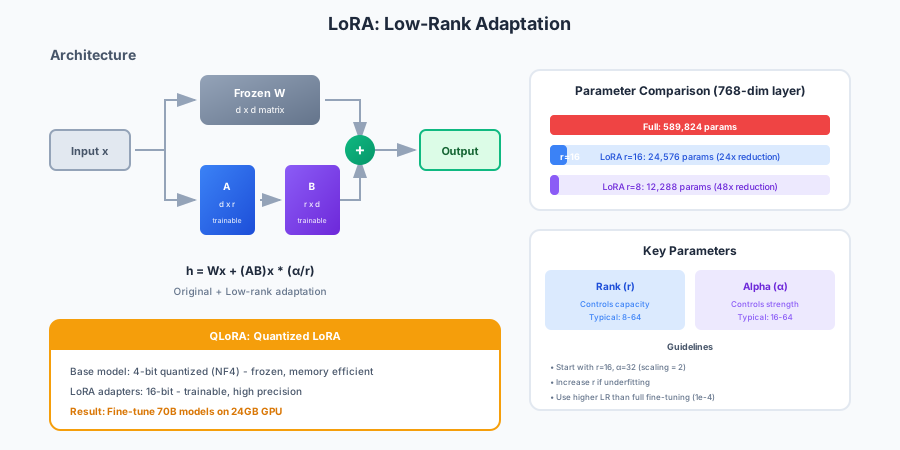
The core assumption: when fine-tuning for a specific task, the weight changes have low intrinsic dimensionality. A full matrix update ΔW can be approximated by the product of two smaller matrices:
ΔW ≈ A × B

Where:
- W is d×d (e.g., 768×768 = 590,000 parameters)
- A is d×r (e.g., 768×16 = 12,288 parameters)
- B is r×d (e.g., 16×768 = 12,288 parameters)
- Total: 24,576 parameters (24x reduction)
The Forward Pass
During inference, the output combines the frozen weights with the learned adaptation:
h = Wx + (A × B)x × (α/r)
Where:
- W: Original frozen weights
- A × B: Low-rank update (trainable)
- α/r: Scaling factor (alpha divided by rank)
Key Insight: Zero Initialization
LoRA initializes:
- A: Random values (Kaiming initialization)
- B: All zeros
This means initially ΔW = A × B = 0, so the model starts with the exact pre-trained behavior. Training gradually learns the adaptation from this stable starting point.
Key Parameters
Rank (r)
Controls the capacity of the adaptation—how much change the model can learn.
| Rank | Parameters per Layer | Use Case |
|---|---|---|
| 4 | Very few | Simple tasks, small datasets |
| 8 | Low | Basic instruction following |
| 16 | Moderate | Good default for most tasks |
| 32 | Higher | Complex domain adaptation |
| 64+ | Many | Very complex tasks |
Guidance:
- Start with r=16
- Increase if model underfits (can't learn the task)
- Decrease if model overfits (memorizes training data)
Alpha (α)
Controls the strength of the adaptation through the scaling factor α/r.
| α/r Ratio | Effect |
|---|---|
| 0.5 | Conservative adaptation |
| 1.0 | Balanced |
| 2.0 | Common choice |
| 4.0 | Strong adaptation |
Common patterns:
- α = r: Scaling factor = 1 (balanced)
- α = 2r: Scaling factor = 2 (common, stronger adaptation)
Target Modules
Which layers to apply LoRA to:
| Strategy | Modules | Trade-off |
|---|---|---|
| Attention only | q_proj, v_proj | Minimal parameters, fast |
| Full attention | q_proj, k_proj, v_proj, o_proj | Better attention control |
| All linear | + gate_proj, up_proj, down_proj | Maximum capacity |
Recommendation: Start with full attention (q,k,v,o projections). Add feedforward layers if needed.
QLoRA: Extreme Efficiency
QLoRA combines LoRA with 4-bit quantization:
| Component | Precision | Memory |
|---|---|---|
| Base model | 4-bit (NF4) | ~3.5 GB for 7B |
| LoRA adapters | 16-bit | ~50 MB |
| Training overhead | 16-bit | Minimal |
Result: Fine-tune a 70B model on a 24GB GPU.
NF4: The Secret Sauce
Normal Float 4-bit (NF4) is optimized for neural network weights that follow a normal distribution:
- Regular 4-bit: 16 evenly spaced quantization levels
- NF4: 16 levels optimized for normal distributions
NF4 has significantly lower quantization error for typical LLM weights.
Double Quantization
QLoRA further reduces memory by quantizing the quantization constants themselves, saving an additional ~0.5 bits per parameter.
Practical Implementation
Using PEFT Library
from peft import LoraConfig, get_peft_model, TaskType
from transformers import AutoModelForCausalLM, AutoTokenizer

# Load base model
model = AutoModelForCausalLM.from_pretrained(
    "meta-llama/Llama-2-7b-hf",
    torch_dtype=torch.float16,
    device_map="auto"
)

# Configure LoRA
lora_config = LoraConfig(
    r=16,                           # Rank
    lora_alpha=32,                  # Alpha (scaling = 32/16 = 2)
    target_modules=["q_proj", "k_proj", "v_proj", "o_proj"],
    lora_dropout=0.05,
    bias="none",
    task_type=TaskType.CAUSAL_LM
)

# Apply LoRA
model = get_peft_model(model, lora_config)
model.print_trainable_parameters()
# Output: trainable params: 4,194,304 || all params: 6,742,609,920 || trainable%: 0.062
QLoRA Setup
from transformers import BitsAndBytesConfig
import torch

# Configure 4-bit quantization
bnb_config = BitsAndBytesConfig(
    load_in_4bit=True,
    bnb_4bit_quant_type="nf4",           # NormalFloat4
    bnb_4bit_compute_dtype=torch.float16,
    bnb_4bit_use_double_quant=True        # Double quantization
)

# Load quantized model
model = AutoModelForCausalLM.from_pretrained(
    "meta-llama/Llama-2-7b-hf",
    quantization_config=bnb_config,
    device_map="auto"
)

# Apply LoRA to quantized model
model = get_peft_model(model, lora_config)
Training Configuration
LoRA requires different hyperparameters than full fine-tuning:
| Parameter | Full Fine-tuning | LoRA |
|---|---|---|
| Learning rate | 1e-5 to 5e-5 | 1e-4 to 5e-4 |
| Weight decay | 0.01 | 0.001 |
| Warmup | 5-10% | 3% |
LoRA parameters start at zero, so they need higher learning rates to learn effectively.
from transformers import TrainingArguments

training_args = TrainingArguments(
    output_dir="./lora_output",
    learning_rate=2e-4,          # Higher than full fine-tuning
    per_device_train_batch_size=4,
    gradient_accumulation_steps=4,
    num_train_epochs=3,
    warmup_ratio=0.03,
    weight_decay=0.001,
    fp16=True,
    logging_steps=10,
    save_strategy="epoch",
)
Multi-Task Adapters
A powerful LoRA feature: train multiple adapters for different tasks using the same base model.
# Train separate adapters
# ./adapters/creative_writing/  (r=32, high capacity)
# ./adapters/code_generation/   (r=16, balanced)
# ./adapters/summarization/     (r=8, focused)

# Load and switch at inference
from peft import PeftModel

base_model = AutoModelForCausalLM.from_pretrained("base_model")

# For creative writing
creative_model = PeftModel.from_pretrained(base_model, "./adapters/creative_writing")

# For code generation
code_model = PeftModel.from_pretrained(base_model, "./adapters/code_generation")
Benefits:
- Single base model in memory
- Swap adapters in milliseconds
- Each adapter is tiny (~50-100MB)
Common Pitfalls
Rank Too Low
Symptoms: Model doesn't learn the task, stuck at baseline performance.
Solution: Increase rank (r=8 → r=16 → r=32). Complex tasks need more capacity.
Rank Too High
Symptoms: Quick overfitting, poor generalization, training loss drops but validation doesn't.
Solution: Decrease rank, add dropout, use more diverse data.
Wrong Learning Rate
Symptoms: Training doesn't converge or is unstable.
Solution: LoRA needs 5-10x higher LR than full fine-tuning. Start at 1e-4.
Missing Target Modules
Symptoms: Limited adaptation, model behavior doesn't change much.
Solution: Add more target modules. Start with attention projections, add feedforward if needed.
When to Use LoRA vs Full Fine-tuning
| Scenario | Recommendation |
|---|---|
| Limited GPU memory | LoRA (or QLoRA) |
| Multiple tasks from same base | LoRA (adapter per task) |
| Maximum possible quality | Full fine-tuning (if resources allow) |
| Quick experimentation | LoRA |
| Production deployment | LoRA (smaller, faster to swap) |
| Very simple task | LoRA with low rank |
| Complex domain shift | Full fine-tuning or LoRA with high rank |
In practice, LoRA often matches full fine-tuning quality at a fraction of the cost.
Merging Adapters
After training, you can merge LoRA weights into the base model for inference efficiency:
# Merge and save
merged_model = model.merge_and_unload()
merged_model.save_pretrained("./merged_model")

# No adapter overhead at inference
# But loses ability to swap adapters
Use merging when:
- Deploying a single fine-tuned version
- Maximum inference speed needed
- Don't need adapter flexibility
Conclusion
LoRA democratizes LLM fine-tuning by making it accessible on consumer hardware:
Core concept:
- Weight updates have low intrinsic rank
- Learn A×B instead of full ΔW
- 10-100x parameter reduction
Key parameters:
- Rank (r=16 is a good default)
- Alpha (α=2r is common)
- Target modules (attention + optionally feedforward)
Practical tips:
- Use higher learning rates than full fine-tuning
- Start simple, add capacity if underfitting
- QLoRA enables even larger models
LoRA with default settings (r=16, α=32) on attention layers is a robust starting point for most fine-tuning tasks.
References
- Hu et al. (2021). "LoRA: Low-Rank Adaptation of Large Language Models". ICLR 2022.
- Dettmers et al. (2023). "QLoRA: Efficient Finetuning of Quantized LLMs". NeurIPS 2023.
- Hugging Face PEFT Documentation - Official library documentation.
- PEFT GitHub Repository - Source code and examples.